At Diamond, Senior Business Consultants Amanda Thacher and Sherrie Jones regularly break down the latest medical aesthetics trends for med spa owners and providers. But their message goes beyond just knowing what is new. As Amanda puts it:
"The clinics that actually grow take the same information and turn it into new services, better consults, higher ticket treatment plans, and stronger patient retention."
Here is a breakdown of the most important updates in aesthetics right now, and more importantly, how to use them inside your business.
Is Radiesse Now Approved for the Décolleté?
Yes. Radiesse (RADS) is now FDA-approved for the treatment of wrinkles in the décolleté area. Clinically, this reinforces the growing role of biostimulators beyond the face. The supporting studies highlight collagen production, skin texture improvement, and ongoing reduction in skin aging over time.
But here is the real opportunity: patients are increasingly aware of aging in the chest area, especially with sun damage and volume loss. They just are not asking for Radiesse by name. They are saying things like “my skin looks older here” or “my makeup does not match my chest.”
That gap between what patients notice and what they ask for is exactly where your revenue opportunity lives.
Amanda describes a clinic she worked with that already had the product, had completed the training, and could offer this treatment, but was not generating meaningful revenue from it:
"No one was bringing it up. If the patient did not ask, it did not get discussed. We made one shift. We trained providers to incorporate upper body aging into every consult where it made sense. Not selling, not pushing. Just educating."
The result? Within 60 days, that clinic went from occasional single treatments to consistently selling packages, bundling Radiesse with laser resurfacing, skincare, and maintenance protocols. Instead of adding one syringe at $800, they were adding $2,000 to $3,000 per patient. Same product, same team, different implementation.
Building comprehensive treatment plans around Radiesse is what moves the needle from a single-treatment mindset to a revenue-generating program.
How to Apply This in Your Clinic:
- Train providers to address upper body aging as part of the standard consultation flow
- Build a layered treatment framework: Radiesse + laser resurfacing + skincare maintenance
- Position it as upper body rejuvenation, not a standalone injectable
- Present phased treatment plans ranging from $2,000 to $4,000 instead of single treatments
How Does Restylane Contour for Temple Hollowing Fit Into Full Facial Balancing?
The approval of Restylane Contour for temple hollowing is more than a new indication. It is a reinforcement of structural aging as a treatment philosophy. Volume loss in the temples contributes to hollowing, a loss of lift, and an overall fatigued appearance. When you treat this area, the impact radiates across the entire face.
Amanda recalls working with a clinic where providers were doing exceptional clinical work, but their consult style was entirely reactive:
"The patient says they want lips or Botox or under-eye filler, and they do that. But those are small one-time visits, $400, $600, $900, and then they move on. When we trained providers to step back and look at the full picture, volume loss, structure, balance, long-term outcomes, everything changed. We saw providers go from $500 an hour to over $1,500 an hour, sometimes close to $2,000. They were not working more. They were not seeing more patients. They were just educating differently."
Increasing revenue per hour starts with how providers frame the conversation, not how many patients they see.
In another clinic, a fully booked provider had a revenue ceiling that the owner could not explain. An audit of the consults revealed the problem: transactional care. Quick talk, quick filler, great outcomes, limited revenue. When that provider shifted from “What would you like to do today?” to “Let us talk about your overall goals and what is going to get you that long-term result,” revenue per hour more than doubled within 90 days, on the same schedule, with the same patients.
Moving away from low-ticket single visits and into high-ticket treatment plans is what separates clinics that are growing from those that are just staying busy.
This is the difference between being busy and being profitable.
How Are Peptides Changing Medical Aesthetics Trends?
Peptides are shifting from a gray area toward structured, regulated use. While peptides are not broadly FDA-approved as drugs, there is movement toward allowing compounding pharmacies to prepare certain peptides under physician oversight.
This is a positive shift because it raises industry standards. As Amanda explains, it also forces a business decision:
"This is where clinics need to decide who they want to be. The one chasing trends, or the one building credible systems."
What Diamond advises clients to do right now:
- Clean up your peptide and weight loss messaging and keep it medically grounded
- Focus communications on outcomes, not novelty
- Build physician-guided, evidence-based protocols that align with where healthcare is heading: personalized, preventative, ongoing care.
How Should Clinics Structure GLP-1 and Hormone Therapy Programs?
GLP-1s have exploded. Clinics are seeing a wave of new weight management patients coming in specifically for weight management and then leaving. That is a massive missed opportunity.
Weight management is rarely just a weight issue. It involves hormones, metabolism, lifestyle, and stress. When clinics start structuring GLP-1s into monthly programs alongside HRT, peptides, and ongoing support, everything changes.
Sherrie outlines the approach:
"Position it as a journey. Explain where their current status is, how they are doing on their current dosage, and once you have stabilized them, introduce what is next. 'Once we stabilize you, we are going to look at your hormones, support your metabolism, and build a long-term plan.' Instead of a one-time visit, the patient understands there is a roadmap."
Patients who understand the full picture, even if they do not commit to everything on day one, are far more likely to stay engaged long-term. That is how you move from inconsistent revenue to a stable, recurring monthly revenue stream.
And the aesthetics connection matters here too. Studies show that patients on GLP-1s lose collagen at accelerated rates, making collagen-stimulating treatments a natural and medically sound add-on to any weight management program. This is part of the broader longevity revolution in aesthetic medicine, where clinics are taking a more comprehensive approach to patient health and aging.
The Real Problem Is Not Your Services. It Is Your Consults.
The thread running through every one of these updates is the same: most clinics do not have a product problem; they have a consult problem.
If your providers only respond to what patients ask for, you will stay at a low ticket average. If they guide the conversation, educate, and expand the opportunity, revenue grows without seeing more patients, adding more hours, or purchasing new equipment.
A common concern from providers is that expanding beyond what the patient asked for feels “salesy.” Amanda addresses this directly:
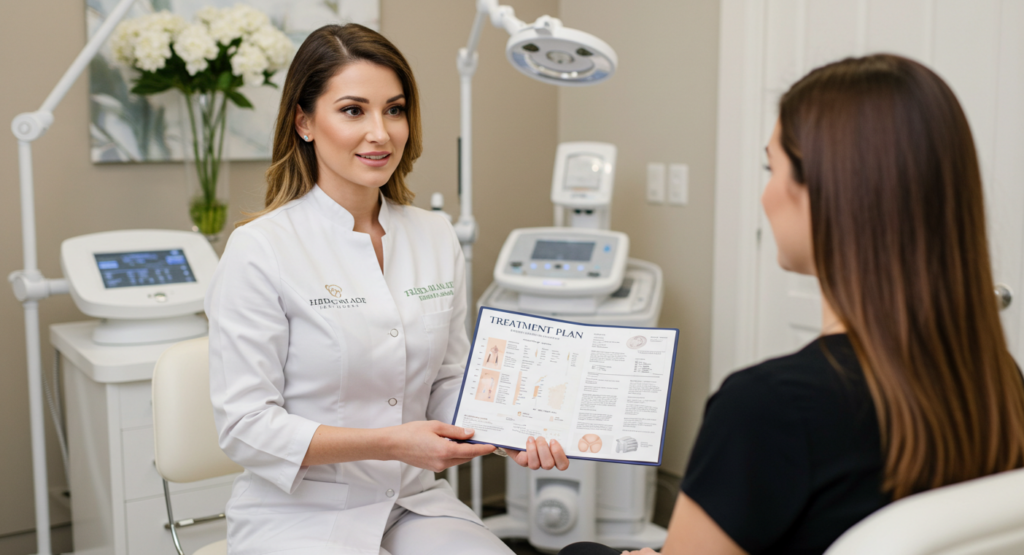
"If a patient comes in asking for lips, but you can clearly see volume loss in the midface, and you do not address it, you are doing them a disservice. The key is how you communicate it. Say: 'Here is what I am seeing overall. Here is what is contributing to that concern. Here is how we can approach it over time.' That is not selling. That is prescribing. That is building a treatment plan."
When providers shift into the role of guide and expert, patients trust them more, not less. Revenue growth rooted in outcomes, not transactions, is what drives long-term retention and profitability.
A Simple Framework to Implement Now:
- Audit your consults. Are providers responding to requests or guiding conversations?
- Standardize your treatment plan frameworks. If a patient presents with chest aging, what is the standard recommendation? Define it.
- Train on the why. Providers need to be confident in explaining the clinical rationale behind expanded treatment plans.
- Introduce phased plans. Do not overwhelm patients with everything upfront. Build the roadmap visit by visit.
- Think in systems, not services. Every FDA approval is a multiplier if your business model is built to use it.
The Bottom Line
FDA approvals create attention. Your business model creates revenue.
Radiesse for the décolleté, Restylane Contour for temple hollowing, evolving peptide regulation, and the GLP-1 boom are all significant. But their impact on your bottom line depends entirely on how your team consults, educates, and plans, not just what is on your service menu.
As Sherrie summarizes it:
"Stop thinking in services. Start thinking in systems, plans, and patient journeys. If your systems are strong, every new treatment becomes a multiplier."
Ready to Turn Industry Updates Into Real Revenue Growth?
If today’s insights resonated with you, imagine what a personalized strategy session with Diamond’s consultants could do for your clinic. Whether you are looking to increase revenue per patient, build recurring income programs, or finally close the gap between how busy your team is and how profitable your practice is, we are here to help.
[Book Your Free Strategy Session →]
No pressure, no pitch. Just a focused conversation about where your clinic is now and what it would take to get it where you want it to be.
Frequently Asked Questions
The most significant trends include the FDA approval of Radiesse for décolleté rejuvenation, Restylane Contour for temple hollowing, increased regulation of peptide therapies under physician oversight, and the rapid growth of GLP-1 weight management programs integrated with aesthetic services.
Train providers to guide consultations rather than just respond to requests. Shifting from single-service visits to structured, phased treatment plans is the fastest way to increase average ticket size on the same schedule.
Present GLP-1 care as a multi-step journey, not a one-time prescription. Once patients are stabilized on their dosage, introduce hormone therapy, metabolic support, and collagen-stimulating treatments. Patients on GLP-1s lose collagen at accelerated rates, making aesthetic add-ons both medically relevant and easy to recommend.
It creates a clinically supported, billable treatment for a concern patients frequently mention but rarely request by name. Bundling Radiesse with laser resurfacing and skincare maintenance can add $2,000 to $3,000 per patient instead of a single syringe fee.
Most revenue is lost not from a lack of treatments but from providers only addressing what patients ask for. A provider who presents a complete treatment plan consistently generates more revenue per hour than one who fulfills single requests, without adding patients, hours, or overhead.